Establishing the status, distribution, breeding ecology and conservation challenges of the Bateleur in Mole National Park, northern Ghana
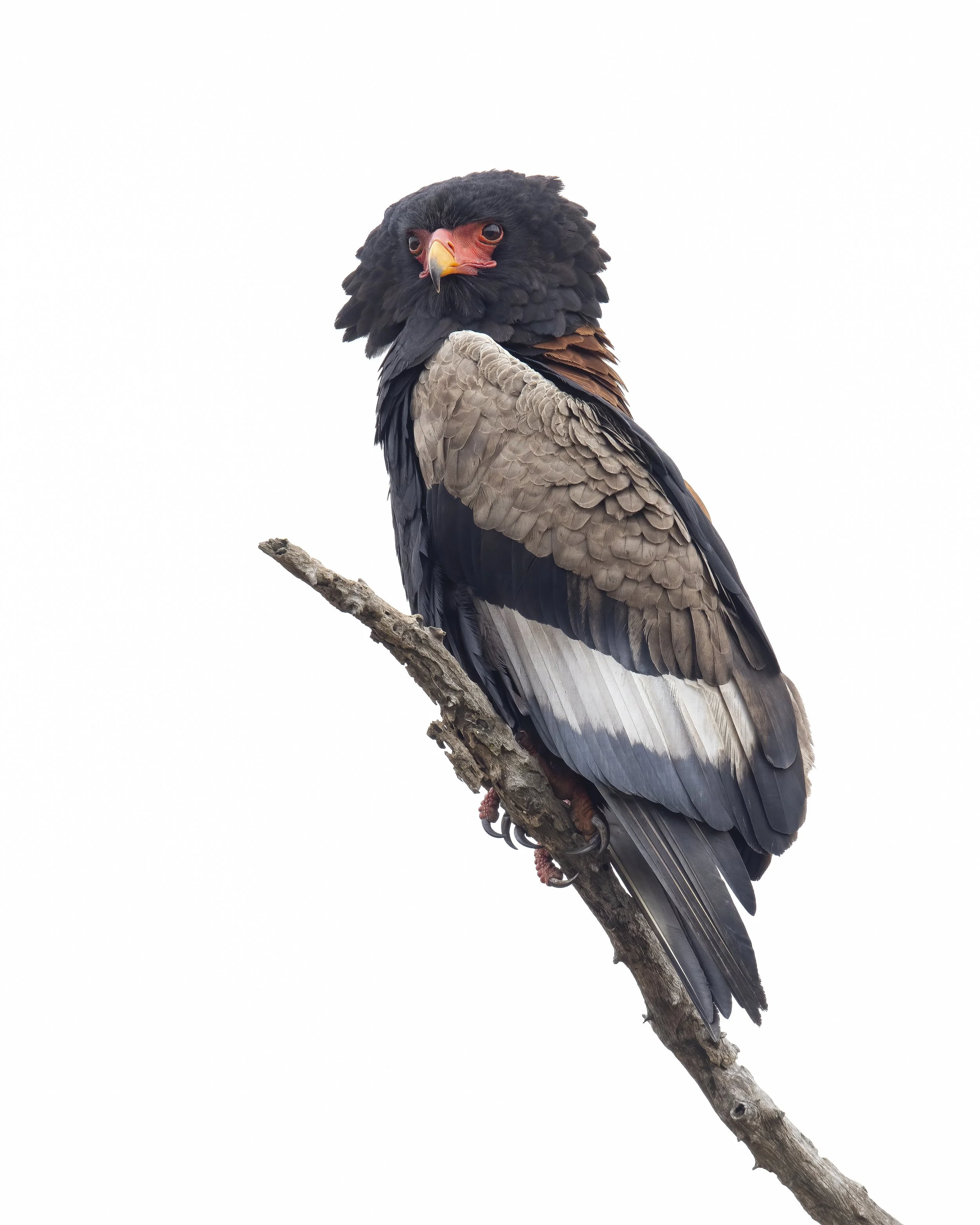
Photo Credit: Dorian Anderson
The Bird Conservation Fund (BCF) is teaming up with the African Bird Club (ABC) to raise $4,067 to for a project that focuses on Bateleur (Terathopius ecaudatus), a large raptor of African savannas, currently listed as Endangered on the IUCN Red List due to severe population declines across its range. Despite its global significance, there is no published baseline information or population data on its status in Ghana, including within Mole National Park: the country’s largest protected area and an Important Bird Area, where the species has been sighted on several occasions.
This project, led by Joseph Kobina Daniels of the West African Primate Conservation Action, Accra Zoo, aims to establish the conservation status of the Bateleur in Mole National Park by combining systematic population surveys with targeted nest searches and local community engagement from August 2026 to August 2027. Surveys will be conducted using road transects across representative habitats in the park and will be informed by previous sightings extracted from the Global Biodiversity Information Facility (GBIF) database. Potential nesting areas will be systematically searched, and a drone will be deployed for safe inspection of nest contents to record clutch size and breeding success without disturbance.
In addition, semi-structured interviews will be carried out with surrounding communities to assess local knowledge, perceptions, and potential threats (e.g. poisoning, hunting, or habitat degradation).
The project will deliver the first comprehensive assessment of the Bateleur in Ghana, providing crucial baseline data on population size, distribution, and breeding ecology. Outputs will include a final technical report, a policy brief for park managers, and community awareness materials. The findings will guide Mole National Park management and national conservation priorities, while contributing to global monitoring of this threatened species.
The Bateleur is renowned for its striking plumage and acrobatic flight. Once widespread across Sub-Saharan Africa, the species has experienced dramatic population declines over the last three generations, estimated at more than 50%. It is currently assessed as Endangered on the IUCN Red List, with habitat loss, poisoning, and persecution being the primary drivers of decline.
Northern Ghana lies within the West African range of the species. However, the Bateleur has received no focused research or publications, and all records in the study area come from incidental observations during surveys of other raptors, especially vultures. Mole National Park (4,840 km²) is Ghana’s largest protected area, harboring extensive Guinea savanna woodland and open habitats suitable for Bateleurs. The park is recognized as an Important Bird Area, yet detailed monitoring of Bateleurs has never been undertaken. Establishing a baseline population and understanding the species’ breeding ecology here are critical, as The Bateleur is renowned for its striking plumage and acrobatic flight. Once widespread across Sub-Saharan Africa, the species has experienced dramatic population declines over the last three generations, estimated at more than 50%. It is currently assessed as Endangered on the IUCN Red List, with habitat loss, poisoning, and persecution being the primary drivers of decline.
Northern Ghana lies within the West African range of the species. However, the Bateleur has received no focused research or publications, and all records in the study area come from incidental observations during surveys of other raptors, especially vultures. Mole National Park (4,840 km²) is Ghana’s largest protected area, harboring extensive Guinea savanna woodland and open habitats suitable for Bateleurs. The park is recognized as an Important Bird Area, yet detailed monitoring of Bateleurs has never been undertaken. Establishing a baseline population and understanding the species’ breeding ecology here are critical, as Mole may represent a stronghold for the species in West Africa (Goded, 2023). Using the GBIF database as reference, we will purposively select transects in Mole National Park to cover more area and effectively estimate encounter rates. This study will be more comprehensive because it focuses directly on Bateleur identification, and unlike past transects that relied solely on cars, we will use motorcycles and walking transects to access areas vehicles cannot reach.
Bateleurs face multiple threats in northern Ghana, as in other parts of their range. These include habitat degradation from shifting cultivation, bushfires, and wood harvesting; poisoning and persecution, often linked to retaliatory killings after carnivore attacks on livestock (which also affect scavenging birds of prey); declining prey availability due to hunting pressure on small mammals and reptiles; and human disturbance, especially near nesting sites. Local community perceptions of the Bateleur are poorly documented in Ghana. Understanding whether the species is valued, ignored, or persecuted is essential for developing conservation strategies.
The BirdLife factsheet highlights major knowledge gaps in Bateleur ecology, especially in West Africa. Under trend justification in the birdlife report, there is no focused mention of Ghana as there is no published data to refer to. There are virtually no published studies on the species in Ghana. Without baseline data, Mole National Park management cannot incorporate the species into conservation planning. This project directly addresses these gaps by establishing population size and distribution through standardized surveys, documenting breeding ecology through nest monitoring, and identifying threats and conservation opportunities through community engagement.
The project will involve local field assistants and invite students, who will receive training in raptor survey techniques, nest monitoring, and community interview methods. This will strengthen local capacity for bird research and conservation.
In summary, the project provides a unique opportunity to generate baseline data for an Endangered African raptor in Ghana’s largest national park, build local capacity, and foster community support for conservation.